
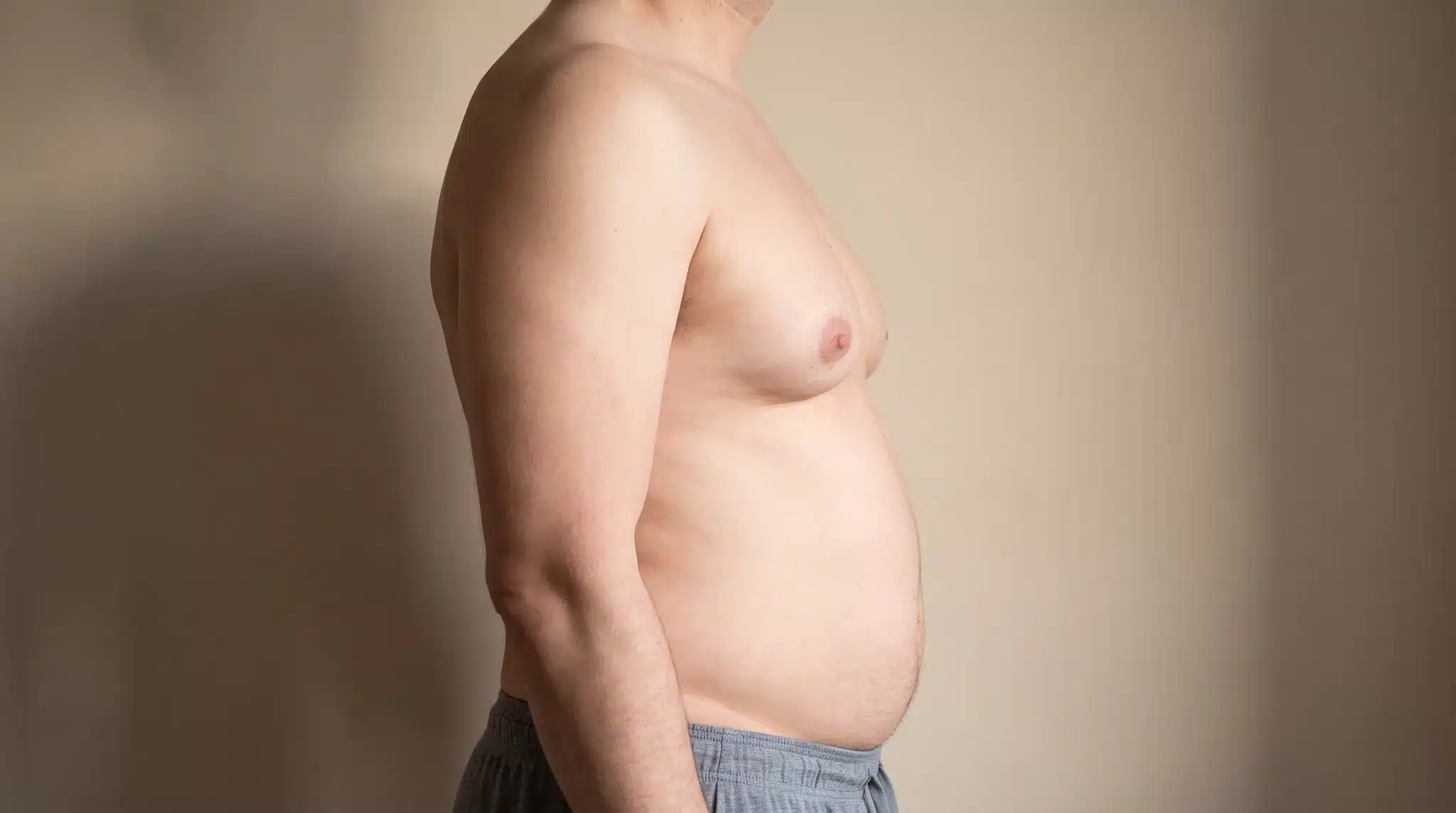
At a glance: Gynaecomastia is the enlargement of the mammary gland tissue in men. Pseudogynaecomastia, by contrast, is an accumulation of fat in the breast without any change in the glandular tissue.
- Hormonal cause: men normally produce more testosterone than oestrogen; a rise in the oestrogen level can enlarge the mammary glands
- Most frequent hormonal triggers: the ageing process with its natural decline in testosterone, medication such as antidepressants or preparations against prostate cancer, diseases of the liver or the thyroid
- Role of excess weight: a raised body fat percentage can cause both gynaecomastia and lipomastia, that is the accumulation of fatty tissue in the breast
- Non-surgical approaches: weight reduction and nutrition, hormonal therapies always under medical supervision, aesthetic treatments without surgery
- Injection lipolysis (fat-dissolving injection): substances are injected into the fatty tissue in order to break down the fat cells
Gynecomastia affects many men and can develop for a variety of reasons. Frequently, a hormonal imbalance or excess weight leads to an enlargement of the breast tissue. There are options for treating gynecomastia without surgery. Non-surgical approaches include weight reduction, hormonal therapies and aesthetic treatments that may help improve the situation.
Fundamentals of Gynecomastia
The fundamentals of gynecomastia encompass several important aspects that contribute to a better understanding of the condition. Factors such as hormonal influences and excess weight play a decisive role.
Causes of an Enlarged Male Breast
The causes of enlargement of the male breast are varied. It often involves a hormonal imbalance, which may stem from a range of physiological and external factors.
Hormonal Influences
A central factor in gynecomastia is hormonal change. Men normally produce higher levels of testosterone compared with estrogen. An increase in estrogen levels, however, can lead to enlargement of the breast glands. The most common hormonal triggers include:
- The ageing process, which leads to a natural decline in testosterone.
- The influence of certain medications, such as antidepressants or drugs used in the treatment of prostate cancer.
- Disorders of the liver or thyroid, which can affect hormone levels.
Excess Weight and Fatty Tissue
Excess weight represents another significant factor that contributes to the development of gynecomastia. An increased proportion of body fat can cause both gynecomastia and lipomastia, the latter describing the accumulation of fatty tissue in the breast.
Difference Between Gynecomastia and Pseudogynecomastia
It is important to distinguish between gynecomastia and pseudogynecomastia. Whereas gynecomastia is an enlargement of the glandular breast tissue, pseudogynecomastia refers to the accumulation of fat in the breast without any change to the glandular tissue.
Diagnostic Procedures
Diagnostics play a central role in gynecomastia, helping to understand the causes of the condition and to determine suitable treatment approaches. Through various procedures, physicians can carry out a comprehensive assessment of the patient’s state of health.
Non-Surgical Treatment Options
Weight Reduction and Nutrition
A central aspect in alleviating gynecomastia is weight reduction. Excess weight can intensify both gynecomastia and lipomastia. By reducing the proportion of body fat, a visible improvement can often be achieved.
Medication and Hormone Therapy
In some cases, drug therapy may be considered in order to address hormonal imbalances. This treatment should always take place under medical supervision in order to ensure safety.
Aesthetic Treatments Without Surgery
In addition to the methods outlined above, there are also non-invasive aesthetic treatments that may be considered.
Fat-Dissolving Injection and Injection Lipolysis
The fat-dissolving injection, also known as injection lipolysis, is a procedure in which substances are injected into the fatty tissue to break down the fat cells. This method may be an option for men who wish to improve the contours of their chest without surgery.
Do you feel uncomfortable with the appearance of your chest? Find out which options for correcting gynecomastia might be suitable for you. Arrange an appointment for a personal consultation at our practice today.
Medically reviewed and written by:
Alejandro Martí – Specialist in Plastic and Aesthetic Surgery 🇩🇪 🇪🇸
Last reviewed: April 2026
Literature & Scientific Sources
- Hurwitz DJ, Davila AA. „Contemporary Management of Gynecomastia.” Clinics in Plastic Surgery. 2022. PubMed PMID 35367036
- Abdali H, Rasti M. „Liposuction versus Periareolar Excision Approach for Gynecomastia Treatment.” Advanced Biomedical Research. 2023. PubMed PMID 37288017
- Ali SS, Ahmed I. „Gynecomastia Surgery: Liposuction Alone versus Liposuction with Endoscope-Assisted Glandular Excision.” Indian Journal of Plastic Surgery. 2025. PubMed PMID 40894818
- Kanakis GA et al. „EAA clinical practice guidelines – gynecomastia evaluation and management.” Andrology. 2019. PubMed PMID 31099174
- Rohrich RJ et al. „Classification and management of gynecomastia: defining the role of ultrasound-assisted liposuction.” Plastic and Reconstructive Surgery. 2003. PubMed PMID 12560721
- Koch T et al. „Marked Increase in Incident Gynecomastia: A 20-Year National Registry Study.” Journal of Clinical Endocrinology & Metabolism. 2020. PubMed PMID 32754750