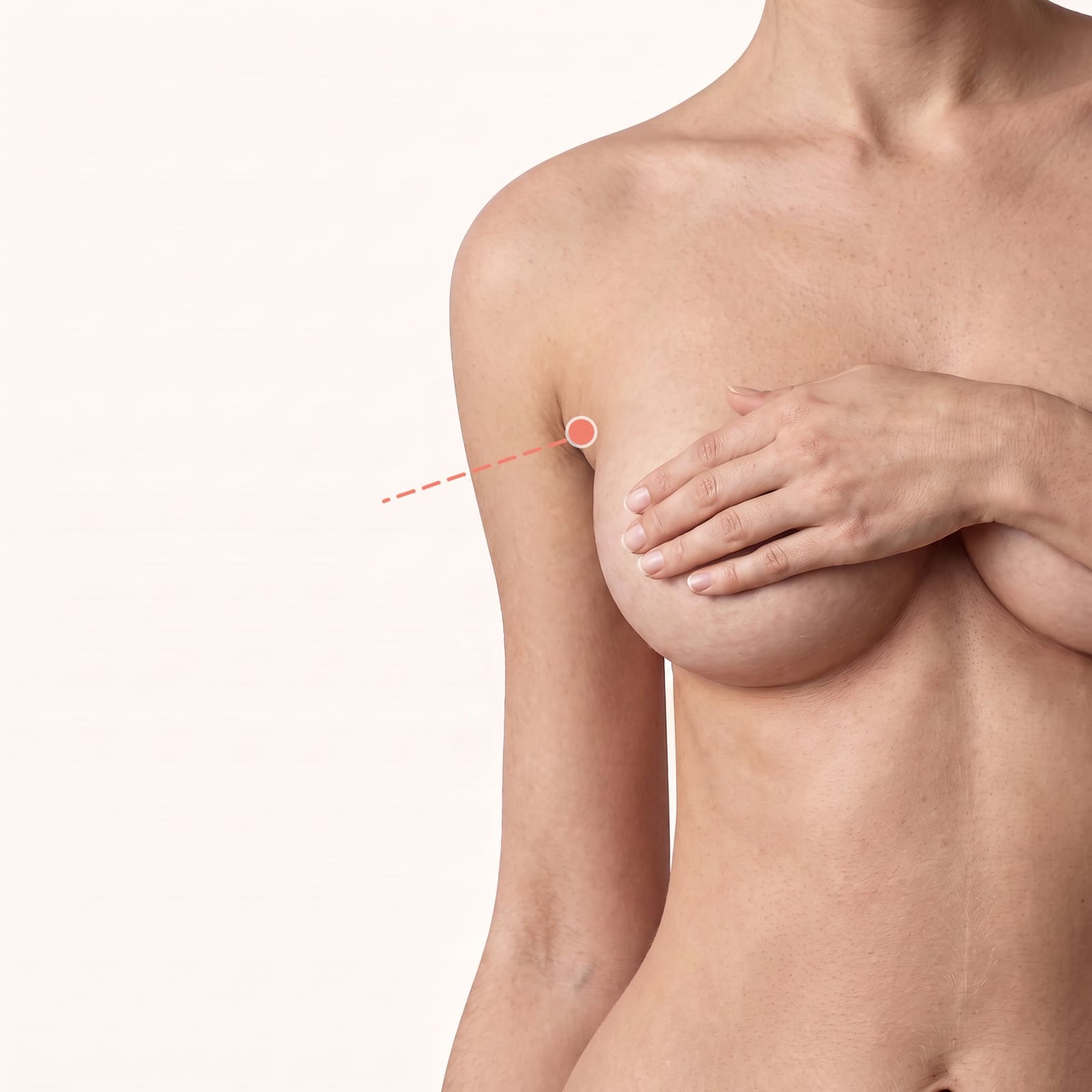
At a glance: In breast augmentation through the armpit (transaxillary), the silicone implant is inserted through a small incision in the armpit, under camera view (endoscopic). The access is via the armpit, not via the breast.
Method: transaxillary access with endoscopic preparation under direct view; depending on the findings, the implant is placed using the dual plane technique or subglandularly
Scar: a small incision in a natural fold of the armpit; no scar is created on the breast itself
Anaesthesia: general anaesthesia
Implants: both round and anatomical (teardrop-shaped) silicone implants can be placed through the access in the armpit; microtextured silicone implants are used
Planning: real trial implants (sizers) for directly trying out different sizes, instead of a digital 3D simulation on a screen
Do you wish for a larger bust but would prefer to avoid any scar on the breast itself? Then breast augmentation through the armpit is well worth a closer look. With this technique, the implant is placed through a small incision in the armpit – under camera guidance (endoscopically). The breast remains free of scars. In this article, you will learn how the procedure works, what its advantages and limitations are, and who it is suited for.
What is transaxillary endoscopic breast augmentation?
“Transaxillary” means that the access is made through the armpit (Latin axilla), not through the breast. Instead of an incision in the inframammary fold or around the areola, the silicone implant is placed through a small incision within a natural skin crease of the armpit. So that the pocket for the implant can be created precisely and under direct vision, I work endoscopically – that is, with a small camera that transmits a magnified view of the surgical field to a monitor.
Access through the armpit is an established method of aesthetic breast surgery and has been studied and refined in the medical literature for years.
The decisive advantage: no scar on the breast
This is the reason many women choose this route: with this approach the incision lies in the armpit: no scar is created on the breast itself. The only – small – scar lies hidden within a natural crease of the armpit and, once healed, is usually difficult to detect. The décolleté, areola and inframammary fold remain entirely untouched. Particularly if you are prone to conspicuous scarring (such as keloids) or are determined to avoid a visible scar on the breast, this route is especially worth considering for you.
How does the procedure through the armpit work?
The procedure is performed under general anaesthesia. The sequence in brief:
Incision: a small incision within a natural crease of the armpit.
Endoscopic dissection under direct vision: A fine HD camera transmits a magnified view of the surgical field to a monitor. This allows me to prepare the pocket for the implant precisely and with care for the tissue – with meticulous haemostasis and accurate shaping of the implant pocket, unlike the blind palpation through the armpit that was common in the past.
Implant position: Depending on the findings, I place the implant using the dual-plane technique (partially beneath the chest muscle) or subglandularly (above the muscle, beneath the gland) – matched to your tissue and your desired result.
No-touch insertion (Keller funnel): Using a funnel-shaped insertion aid, the implant glides into the prepared pocket by the no-touch method – with minimal contact with skin and bacteria. This is regarded as a measure that may reduce the risk of capsular contracture.
Closure: fine wound closure in the armpit.
The endoscopic technique is central here: it replaces “blind” palpation with controlled dissection under vision – an aspect discussed in comparative studies as an advantage in terms of precision.
Why endoscopically? The advantages of direct vision
Access through the armpit was once a technique performed without direct vision. Endoscopy has fundamentally changed this: today I perform the procedure under direct vision. This brings concrete advantages for you:
Precise haemostasis under vision, which can reduce bruising.
Accurate shaping of the implant pocket for a harmonious, natural result.
The inframammary fold remains untouched – this contributes to the stability of the implant position and helps prevent the implant from descending.
Which implants and which positions are possible?
Through the access in the armpit, both round and anatomical (teardrop-shaped) silicone implants can be placed. Which size, which profile and which position are suitable for you depends on your individual starting situation – on your chest, the quality of your skin and your desired result. You can find more about the implant shapes on our page on breast augmentation with implants.
I use micro-textured silicone implants. Their finely structured surface supports a stable position within the tissue and combines properties of smooth and more heavily textured implants in a balanced profile.
The access routes compared: armpit, breast fold, areola
There are three established access routes for breast augmentation with implants. Which one suits you depends on your anatomy, the chosen implant and your priorities. An honest overview:
Through the armpit (transaxillary): The incision sits in a natural skin fold of the armpit; the breast itself remains free of scars. Performed endoscopically, under camera vision, the implant pocket can be prepared precisely and with little bleeding. Limitations: with pronounced sagging, or when a lift is needed at the same time, this route is usually not suitable.
Breast fold (inframammary): The most frequently used access worldwide, with direct view of the implant pocket. The scar sits in the fold under the breast and is usually hidden when standing. For revisions and a later implant exchange this route is often the first choice.
Areola edge (periareolar): The scar runs along the transition between areola and lighter skin and can heal inconspicuously. The route passes close to the glandular tissue, which can carry a higher risk of temporary changes in nipple sensitivity.
And the access through the navel (transumbilical)? It is described in the literature but plays hardly any role in practice today, among other reasons because only saline-filled implants can be used and control of the implant pocket is limited.
There is no single best access for everyone, only the right one for your anatomy and your priorities. That is exactly what we clarify in the personal examination.
Who is the armpit method suited for – and who not?
Well suited if:
you would prefer no scar on the breast and would rather hide it in the armpit,
this is a first breast augmentation,
your skin and tissue quality is good and there is no pronounced sagging.
Less suited if:
there is significant breast sagging (ptosis) – in which case an additional breast lift is usually needed, which cannot be performed through the armpit alone,
previous operations already make the access more difficult.
Whether the method is the right one in your case is something we assess together during a personal consultation.
Advantages and limitations at a glance
Advantages
Limitations
No scar on the breast – hidden in the armpit
Not sufficient on its own in cases of pronounced ptosis
Endoscopic dissection under direct vision
Requires good skin/tissue quality
Untouched décolleté and areola
Revision procedures may require a different access
Inframammary fold remains untouched – stable implant position
Requires endoscopic experience on the part of the surgeon
Recovery after breast augmentation through the armpit: week by week
Every healing process is individual. The following figures are an orientation, not a promise; what counts is the assessment at your follow-up visits.
The first days: A feeling of tightness and swelling are normal. You wear a medical support bra and rest your arms; avoid movements above shoulder height at first. Showering is usually possible from day 2; afterwards the small scar in the armpit is carefully patted dry.
Weeks 1 to 2: Most patients return to everyday life after 7 to 10 days, to desk work correspondingly earlier depending on how you feel. The armpit region is still treated gently, with wound checks at the practice.
Weeks 3 to 6: A step-by-step return to more activity. No upper-body strength training and no heavy lifting; the support bra stays with you for 4 to 6 weeks in total.
From week 6: In consultation with us, sport is usually possible again. You assess the final result together with us after a few months, once swelling has subsided and the tissue has settled.
If anything seems unusual: contact us, we will take a look in person.
What does breast augmentation through the armpit cost?
For breast augmentation with implants, BONITAS works with a guide price from €6,500. The binding price for your procedure follows from the choice of implant, the implant position and the extent of surgery; after the personal examination you receive a transparent cost estimate. You can find all guide prices in our price overview.
A real fitting instead of 3D simulation: my personal method
Many practices advertise digital 3D simulations on screen. I deliberately take a different approach. With me, you try out different sizes directly using real trial implants (sizers) – you see and feel the volume and weight immediately on your own body. This tactile sense of your own body gives you a more honest impression of the result than any image on a monitor.
On this basis, we then choose together the implant that best suits your individual breast footprint, your breast base and your natural breast shape. This way it is not software that makes the decision, but you – together with me.
Literature & Scientific Sources
Luan J. “Endoscopic-Assisted Transaxillary Breast Augmentation.” Clinics in Plastic Surgery. 2023. PubMed PMID 36396254
Boliglowa D et al. “Transaxillary Breast Augmentation: A Randomized Controlled Trial Comparing a New Semiendoscopic Video-Assisted Technique versus the Blind Technique.” Plastic and Reconstructive Surgery. 2026. PubMed PMID 41115293
Dominic JL et al. “Endoscopic Transaxillary Approach for Breast Augmentation: What does the Evidence Say and What Else Can be Done?.” Aesthetic Plastic Surgery. 2022. PubMed PMID 34561726
Lee DW et al. “Endoscopic Transaxillary Versus Inframammary Approaches for Breast Augmentation Using Shaped Implants: A Matched Case-Control Study.” Aesthetic Plastic Surgery. 2019. PubMed PMID 30911772
Sim HB et al. “Transaxillary endoscopic breast augmentation with shaped gel implants.” Aesthetic Surgery Journal. 2015. PubMed PMID 26104477
Strock LL. “Transaxillary Breast Augmentation: Selection of the Incision, Pocket, and Surgical Technique.” Clinics in Plastic Surgery. 2026. PubMed PMID 41826043
Medically reviewed and written by Alejandro Marti – Specialist (Facharzt) in Plastic and Aesthetic Surgery 🇩🇪 🇪🇸. Last reviewed: June 2026.
Frequently Asked Questions (FAQ)
Does the breast stay without a scar?
The only incision lies within the crease of the armpit. No scar arises on the breast itself.
Can I breastfeed after a breast augmentation through the armpit?
Since the areola and milk ducts are not divided, the ability to breastfeed is generally not affected by this access. However, the ability to breastfeed can never be guaranteed in general.
Is the method suitable for every woman?
No. It is particularly suited to a first breast augmentation without pronounced sagging. In cases of breast ptosis, an additional lift is often advisable.
What does breast augmentation through the armpit cost?
For breast augmentation with implants, BONITAS works with a guide price from €6,500. You receive the binding price for your procedure after the personal examination as a transparent cost estimate; all guide prices are listed in our price overview.
Will there be a visible scar on the breast?
No, with the transaxillary method there is no scar on the breast itself. The small incision sits in a natural skin fold of the armpit and usually heals inconspicuously there.
Can the procedure be performed on an outpatient basis?
Yes, we perform breast augmentation on an outpatient basis or with a short overnight stay. What suits you best is decided together in the personal consultation.
Total: 60 reviews from our Google Business Profile. As of: 09.09.2026.
AAnja Bauer13.05.2026
I can wholeheartedly recommend Dr. Marti! I had a breast augmentation with my own fat as well as a belly button correction done with him. In addition, an umbilical hernia was corrected by another surgeon, together in one operation. I am so happy with the result! It looks really natural and I am simply infinitely grateful! From the very beginning I always felt comfortable, taken seriously and in the best hands. I would especially like to point out that Dr. Marti was the first doctor to recognize my umbilical hernia and immediately recommended a further examination, which I found very attentive and extremely competent. Whenever I had questions or uncertainties I was always helped right away, which I appreciated a lot. I would also like to give very special praise to Jasmin: so friendly, empathetic and dedicated. She made the whole process even more pleasant and took a lot off my shoulders ❤️ Thank you so much for everything!
Translated from German
JJessica F.28.01.2026
While looking for a breast augmentation, I came across BONITAS through my online research. The website immediately gave me a good feeling. Reputable, modern, simply trustworthy. This positive feeling was confirmed from the very first moment. Dr. Marti is an exceptionally empathetic doctor who takes a lot of time, listens and responds to all wishes and questions with calm and great professionalism. The explanation was thorough, understandable and took away all of my fear. From the beginning I felt taken seriously and very well cared for. The practice is beautiful and very invitingly designed. You immediately feel comfortable and welcome. The operation itself went absolutely smoothly, and the result far exceeded my expectations. I am overjoyed and could not have imagined a nicer result. A very special thank you also goes to his assistant: incredibly warm, loving and at the same time highly professional. I am infinitely grateful that I chose BONITAS, and would recommend this clinic as well as Dr. Marti at any time and from the bottom of my heart. Muchísimas gracias 🙂 <3
Translated from German
MMelanie05.11.2025
For several years I had the strong wish for a breast augmentation or rather a breast correction, I went again and again to one or another plastic surgeon for a consultation appointment. I always came away with little hope and great doubts.. since my starting situation was not really easy, none of the previous surgeons was really keen to operate on me. Until I came across Dr.Marti in 06/2025 over the internet, and at the first appointment I was more than surprised, and so for the first time I had a good gut feeling after an appointment like that, he did not put dreams in front of my eyes, but rather what you can simply expect in this case or rather what is possible. He fulfilled my big wish for a natural result 100%. Mr. Marti's assistant also accompanied me lovingly along this path. 4 weeks later the operation took place, which went smoothly. The aftercare appointments were all very relaxed and pleasantly arranged too. The stay at the clinic was unique as well. I can recommend Dr. Marti from the deepest of my heart, he has given me back my self confidence and did not promise too much. I would let him operate on me again at any time.
Translated from German
Reviews from Google, reproduced unchanged. We do not carry out our own verification of authenticity. See our reviews · Google profile