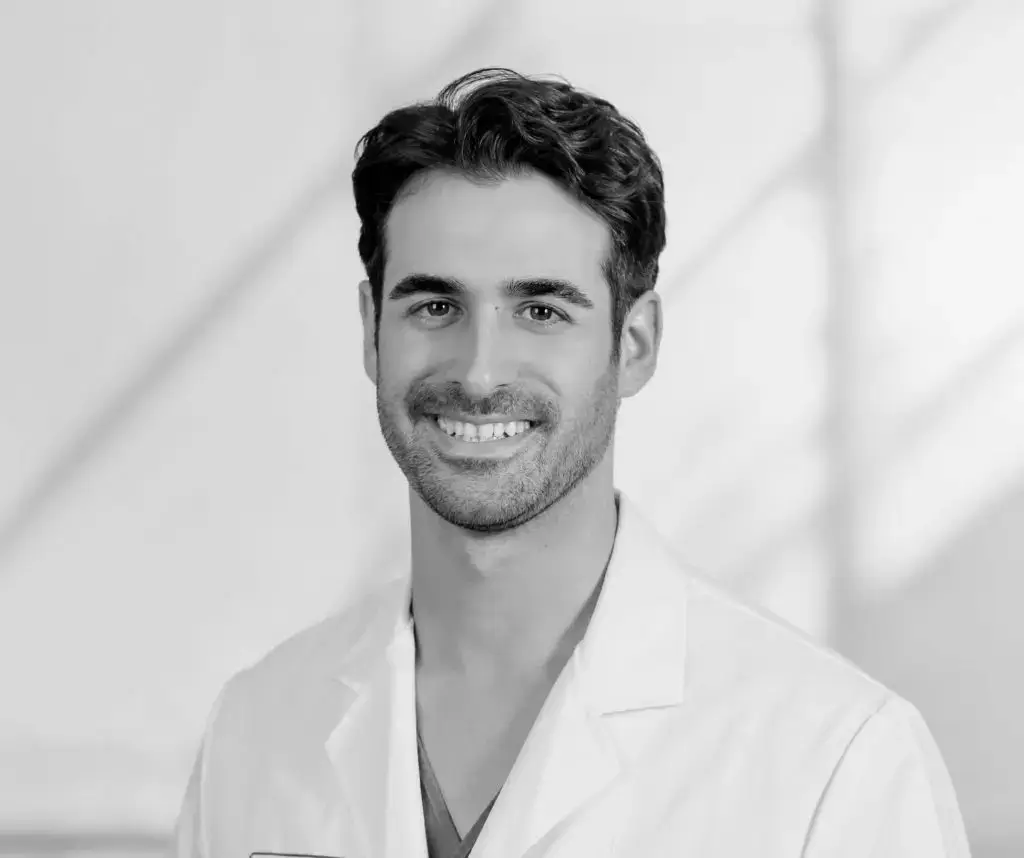
You want a fuller bust, but you don’t want anyone to be able to tell that you’ve had work done? That is precisely what most people mean when they search for a “natural breast augmentation.” It is less about a specific volume in millilitres than about a coherent overall picture: a breast that suits your body, feels soft and looks genuine in motion. On this page you will learn which factors determine a natural look — from your anatomy to shape, position and profile, through to the question of when autologous fat is the particularly natural route. Your surgeon is Alejandro Martí, board-certified specialist in plastic and aesthetic surgery (Facharzt für Plastische und Ästhetische Chirurgie) at the BONITAS practice at Kornmarkt 4.
What “natural” really means in a breast augmentation
Natural appearance is not a product you select; it is the result of many carefully coordinated decisions. A breast looks natural when its proportions suit your chest and your build, when the transition from the upper to the lower breast pole is gentle, and when the tissue feels soft. A pure figure in millimetres or millilitres says little about this — two women with an identical increase in volume can look entirely different, depending on their underlying anatomy and the technique used.
It helps to think in terms of a balanced relationship rather than a maximum value. In plastic surgery there are concepts that describe exactly these relationships: the so-called ICE principle, for example, defines how the upper and lower breast poles, the position of the nipple and the distribution of volume should relate to one another so that a breast looks balanced. Such design rules are not a rigid template but a point of orientation, helping to make your individual result both predictable and harmonious.
Anatomy first: proportion, breast base and skin quality
Before any discussion of method or volume, your anatomy comes first. It determines what leads to a natural result — and where the limits lie. Three points are particularly important here:
- The width of the breast base. This determines how much volume can be distributed harmoniously. A narrow base supports less than a wide one without pushing the breasts apart unnaturally.
- Skin quality and the existing glandular and fatty tissue. Firm tissue that provides good coverage allows more leeway, whereas thin skin shows contours more readily.
- The proportion to your chest. Shoulder width, rib shape and height all contribute to determining which size looks coherent on you.
What looks natural in your case follows from these factors. This is precisely why a suitable result cannot be determined with an online calculator, but only in a personal examination in which measurements, tissue and your wishes are brought together.
Which factors influence a natural result (shape, position, profile)
Once anatomy and your wishes have been clarified, three technical levers above all determine how natural the result looks:
Shape
Shape describes how the volume is distributed. A gentle transition at the upper breast pole and a somewhat fuller lower pole correspond to what most people perceive as natural. The shape arises from the interplay between tissue, the chosen volume and — in the case of implants — the profile of the implant.
Position
Position refers to the plane in which the volume is placed — for example, above or partly beneath the chest muscle. This choice influences how softly the upper pole tapers and how well the edges are concealed. Scientific work on retropectoral placement shows that it can achieve a natural appearance and good control of the breast shape. Which position suits you depends on your tissue coverage.
Profile
Profile describes the relationship between width and projection — that is, how far the breast builds forward. A moderate profile that matches the width of your breast base is generally more natural-looking than a very pronounced projection on a narrow base. The principle here is that the volume should be subordinate to the anatomy, not the other way around.
Breast augmentation with autologous fat as a particularly natural route
If you place value on maximum naturalness and would prefer no foreign material, breast augmentation with autologous fat may be the right route for you. In this procedure, your body’s own fat is harvested from an area with a surplus — such as the abdomen, flanks or thighs — processed, and introduced into the breast in fine layers. The volume comes entirely from you, feels soft and, provided it takes, integrates permanently.
This natural character does, however, have a clear profile that is part of honest patient information:
- The increase in volume per session is moderate — autologous fat is suited to a subtle enlargement, not to a large augmentation in a single step.
- A proportion of the transferred fat is broken down again by the body, which is why the final result is only established after several months and a second session is sometimes advisable.
- As a side benefit, the harvest area is contoured at the same time.
Review articles on the use of autologous fat in aesthetic breast surgery describe the procedure, when the indication is set carefully, as an established route. Comparative studies between autologous fat and implants also show that both methods can lead to good satisfaction in patients who have been realistically counselled — which route suits you depends on your initial findings and your wishes, not on any blanket superiority of one method or the other.
Realistic expectations rather than maximum volume
The most common reason for dissatisfaction is not the technique but an expectation that does not match the anatomy. A natural result and the largest possible volume often exclude one another: the further you go beyond what your breast base and skin coverage can carry, the more likely you are to lose precisely the naturalness you were actually looking for.
It makes more sense to define the goal through the overall picture rather than through a number. Ask yourself how the breast should feel, how it should look in motion and in clothing, and which relationship to your body you perceive as coherent. Studies that record patient-reported outcomes after breast augmentation using standardised questionnaires such as the BREAST-Q make clear that subjective well-being and the fit with one’s own body play a central role in satisfaction — not the size achieved on its own. A realistic, well-supported plan is therefore the most important lever for a result you will be satisfied with in the long term.
Individual planning for a natural result at BONITAS
At our practice, every breast augmentation begins with a thorough examination and an honest conversation. We measure your breast base, assess skin quality and tissue, and discuss which shape, position and profile — or whether the autologous-fat route — suit your anatomy and your wishes. Instead of a millimetre calculator, you receive an overall concept for a natural look.
Your surgeon is Alejandro Martí, board-certified specialist in plastic and aesthetic surgery with dual licensure in Germany and Spain. We deliberately avoid promises and superlatives and address limits and alternatives openly as well. If you are considering which route suits you for a coherent result, you are welcome to arrange an appointment at our practice at Kornmarkt 4.
A genuine try-on rather than a 3D simulation: my personal method
Many practices advertise digital 3D simulations on a screen. I deliberately take a different path. With me, you try out different sizes directly using real sizers (trial implants) — you see and feel the volume and weight immediately on your own body. This tactile sense of your body gives you a more honest impression of the result than any image on a monitor.
On this basis, we then choose together the solution that is right for you and that fits your individual breast footprint, your breast base and your natural breast shape optimally. In this way, it is not a piece of software that makes the decision, but you — together with me.
Frequently asked questions
What makes a breast augmentation look natural?
The result looks natural above all when volume, shape and profile suit your anatomy: a size that matches the breast base, a gentle upper breast pole and a soft feel to the touch. What matters is the coherent overall picture, not a specific value in millilitres.
Is autologous fat more natural than an implant?
Autologous fat requires no foreign material and feels very soft, but the volume per session is limited. Implants allow a predictable, larger augmentation and can likewise look natural with a suitable position and profile. Neither method is superior across the board — it depends on your findings and your wishes.
Why can no one guarantee me an exact size in advance?
Because the result depends on factors such as the breast base, skin quality, tissue and — in the case of autologous fat — individual healing-in. A sound assessment is only possible after a personal examination. Online calculators cannot replace this individual evaluation.
Literature & Scientific Sources
- Mallucci P et al. “Design for Natural Breast Augmentation: The ICE Principle.” Plastic and Reconstructive Surgery. 2016. PubMed PMID 27219229
- Yordanov YP. “Natural Appearance and Good Control of the Breast Shape in Retropectoral Augmentation Mammaplasty: Achievable Without Texturization.” Aesthetic Plastic Surgery. 2020. PubMed PMID 32430555
- AlGhanim K et al. “Fat Grafting Versus Implants: Who’s Happier? A Systematic Review and Meta-analysis.” Plastic Surgery (Oakville, Ont.). 2025. PubMed PMID 39876856
- Jayasinghe RT et al. “Patient Reported Outcome Measures After Breast Augmentation – Using the BREAST-Q IS.” Patient Related Outcome Measures. 2022. PubMed PMID 35046741
- Davis MJ et al. “Application of Fat Grafting in Cosmetic Breast Surgery.” Seminars in Plastic Surgery. 2020. PubMed PMID 32071576
Medically reviewed and written by Alejandro Martí — board-certified specialist in plastic and aesthetic surgery 🇩🇪 🇪🇸. Last reviewed: May 2026.