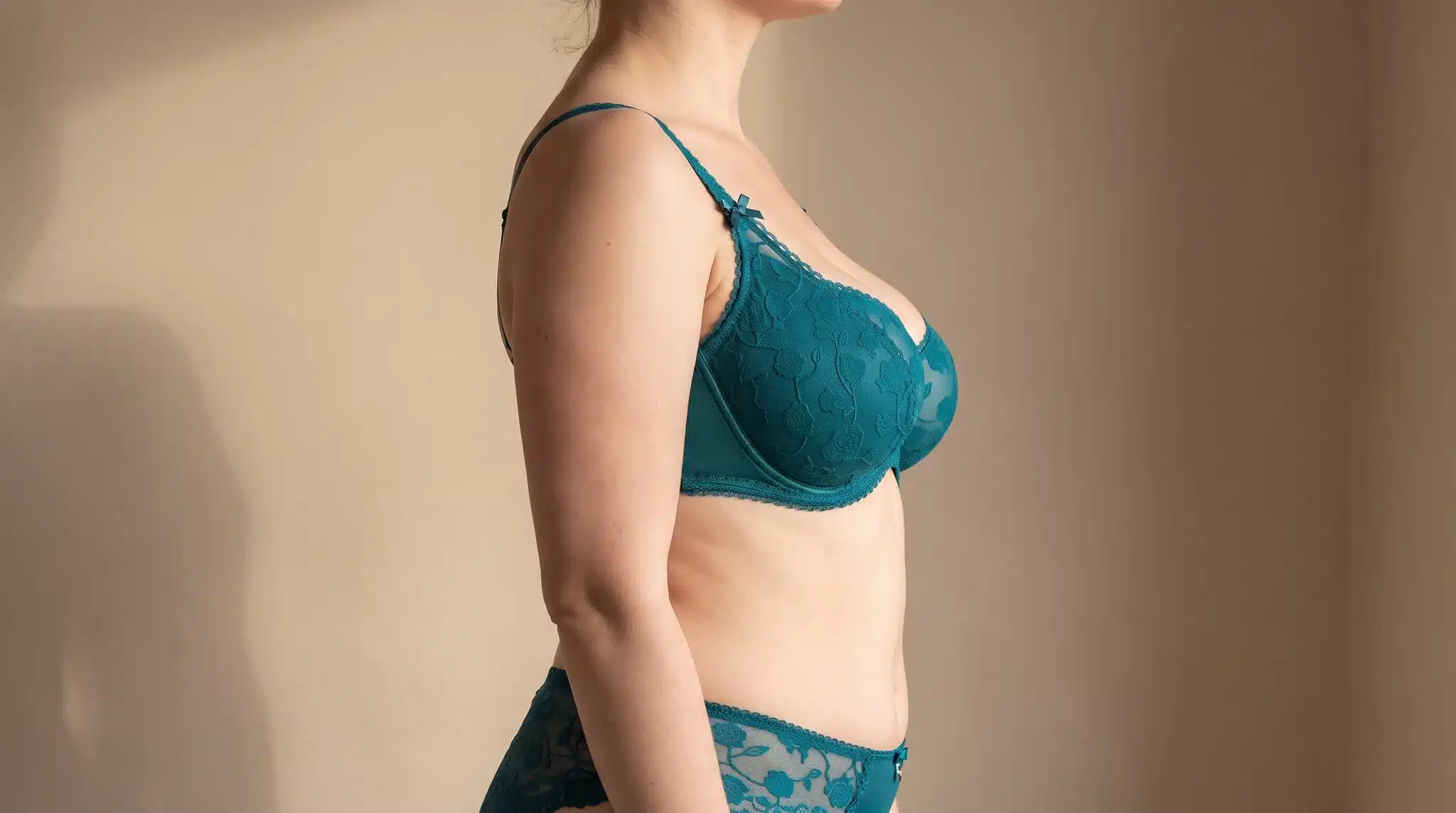
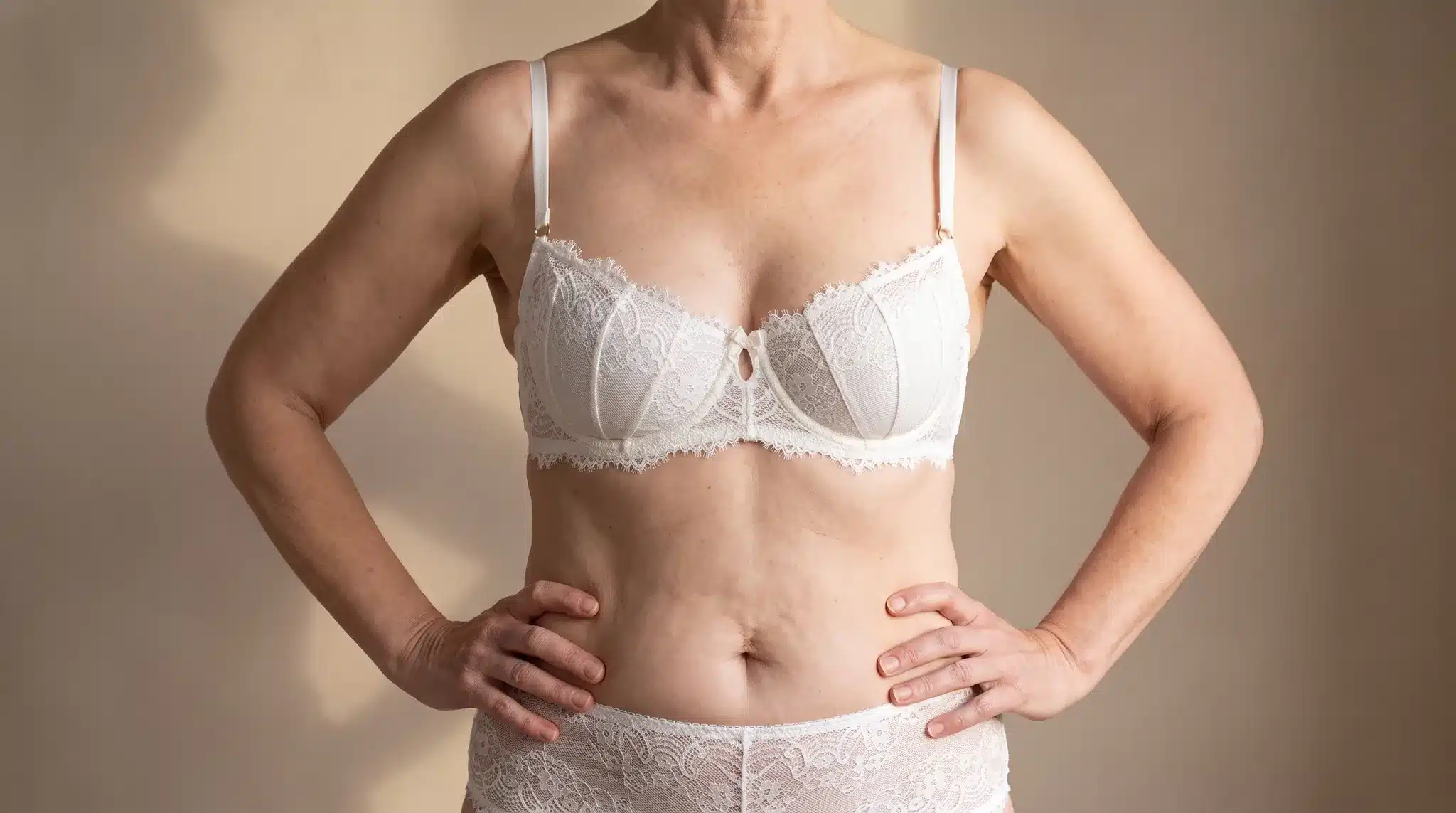
At a glance: A sagging breast (mastoptosis or breast ptosis) develops because the breast has no muscle of its own: it is held in position only by the Cooper ligaments and the elasticity of the skin. If these structures give way, the breast drops.
- Main causes: gravity and ageing, pregnancy, weight fluctuations, genetic predisposition, large breasts, smoking, UV radiation, menopause
- Time course: the Cooper ligaments already start to lose tension from the end of the 20s, and after the menopause the process speeds up markedly
- Not breastfeeding: what is responsible is the change in volume during pregnancy, and women who do not breastfeed develop a comparable ptosis
- Grades according to Regnault: Grade I: nipple at most 1 cm below the inframammary fold; Grade II: 1-3 cm below it, still pointing forwards; Grade III: clearly below it, pointing downwards
- What training does: chest muscle training firms the pectoralis muscle, not the breast itself; an existing ptosis can only be corrected surgically
Causes of Breast Sagging — Why the Breast Loses Firmness
Breast sagging — known medically as mastoptosis or breast ptosis — is one of the most common aesthetic changes of the female breast. Almost every woman experiences some degree of breast laxity over the course of her life. But which factors are truly responsible? And when does a surgical lift make sense? In this article we examine the causes of breast sagging from a medical perspective — evidence-based and free of myths.
Anatomy of the Breast — Why Laxity Is Natural
To understand the causes of breast ptosis, it helps to look at the anatomy. The female breast consists of:
- Glandular tissue — responsible for volume and the ability to breastfeed
- Fatty tissue — helps determine size and shape
- Cooper’s ligaments — connective-tissue suspensory bands that anchor the breast to the chest muscle
- Skin — the outer envelope, whose elasticity diminishes over time
The breast has no muscle of its own. It is held in position solely by Cooper’s ligaments and the elasticity of the skin. When these structures give way, the breast descends — which is initially a normal biological process.
The Most Important Causes of Breast Sagging at a Glance
Gravity and Ageing
The most important and unavoidable factor: gravity acts on the breast tissue every single day. With increasing age, Cooper’s ligaments lose tension, the skin becomes thinner, and collagen production declines. This process begins as early as the late twenties and accelerates markedly after menopause.
Pregnancy and Breastfeeding
During pregnancy the breast enlarges considerably as a result of hormonally driven growth of the glandular tissue. The skin and ligaments are stretched. After breastfeeding, the glandular tissue recedes, but the stretched skin remains — resulting in what is known as excess skin. This effect intensifies with each subsequent pregnancy.
Important to know: it is not breastfeeding itself that causes the laxity, but the change in volume during pregnancy. Studies show that women who have not breastfed develop a comparable degree of ptosis.
Weight Fluctuations
Significant weight gain enlarges the breast through fat deposition. With subsequent weight loss, the fat disappears, but the stretched skin does not retract to the same degree. The so-called yo-yo effect is particularly taxing: repeated cycles of gaining and losing weight place lasting strain on the connective tissue.
Genetic Predisposition
Skin quality, the firmness of the connective tissue, and breast shape are to a considerable extent genetically determined. Some women naturally have firmer skin and stronger Cooper’s ligaments, while others are prone to ptosis even at a young age — independent of pregnancy or weight.
Large Breast Size
The larger and heavier the breast, the more strongly gravity acts upon it. Women with naturally large breasts (macromastia) develop ptosis more frequently and earlier than women with smaller breasts. The tissue is simply subjected to greater strain.
Smoking
Nicotine demonstrably damages the collagen and elastin fibres of the skin. The skin loses elasticity and ages more quickly. Studies have shown a significant association between years of smoking and the degree of breast ptosis. Smoking is one of the few avoidable risk factors.
UV Radiation
Intense sun exposure — particularly in the décolletage area — accelerates skin ageing by destroying collagen and elastin fibres. This effect is known as photoageing and is cumulative: the damage builds up over the years.
Hormonal Changes
Menopause leads to a fall in oestrogen levels, which reduces collagen production in the skin and causes the glandular tissue to recede. The breast loses both volume and firmness at the same time — a twofold effect.
Regnault Ptosis Grades — When Is It Considered Breast Sagging?
In plastic surgery, the degree of breast laxity is classified according to the Regnault classification. The decisive factor is the position of the nipple (mamilla) in relation to the inframammary fold:
- Grade I (mild): The nipple is level with the inframammary fold or at most 1 cm below it
- Grade II (moderate): The nipple is 1–3 cm below the inframammary fold but still points forward
- Grade III (advanced): The nipple is well below the fold and points downward
- Pseudoptosis: The nipple is still above the fold, but the lower breast tissue hangs over the fold — common after breastfeeding
Can Breast Sagging Be Prevented?
Prevention is limited, since many factors cannot be influenced (genetics, pregnancy, ageing). Nevertheless, there are measures that can slow the process:
- Not smoking — the most effective avoidable protective factor
- Sun protection for the décolletage — at least SPF 30
- Stable weight — avoiding pronounced fluctuations
- A well-fitting bra — especially during exercise, to reduce mechanical strain
- Skin care — moisturising, ideally with retinol or vitamin C
Important: chest-muscle training does not firm the breast itself, but rather the underlying pectoralis muscle. It can lift the breast slightly in appearance, but cannot reverse existing ptosis.
When Is a Breast Lift an Option?
When the distress caused by breast laxity is considerable and conservative measures have been exhausted, a breast lift (mastopexy) can restore the shape of the breast. During a mastopexy, excess skin is removed, the breast tissue is reshaped, and the nipple is repositioned into a natural position.
In many cases the lift is combined with an augmentation (implant or autologous fat) in order to replace lost volume at the same time. A combination with a reduction is likewise possible.
At BONITAS, Alejandro Martí, specialist in Plastic and Aesthetic Surgery, advises you personally on your individual situation. In a detailed consultation, you will analyse together which procedure makes sense — or whether surgery is the right path for you at all.
Frequently Asked Questions
Is breast sagging normal?
Yes, breast ptosis is a normal part of the ageing process and affects nearly every woman to varying degrees. It is not a disease but a natural change.
Can exercise reverse breast sagging?
No. Training can strengthen the chest muscle, but the breast itself consists of fatty and glandular tissue with no muscle of its own. Existing ptosis can only be corrected surgically.
Does breastfeeding cause breast sagging?
Not breastfeeding itself, but rather the hormonally driven change in volume during pregnancy, is responsible. Women who have not breastfed develop a comparable degree of ptosis.
At what age does breast sagging occur?
The first changes often begin from the age of 30. After pregnancies, with pronounced weight fluctuations, or with a genetic predisposition, ptosis can also appear earlier. After menopause the process accelerates.
Does statutory health insurance cover a breast lift?
As a rule, a breast lift is classified as an aesthetic procedure and is not covered by statutory health insurance. Where there is a concurrent medical indication (e.g. macromastia with symptoms), an application may be worthwhile on a case-by-case basis.
Medically reviewed and written by:
Alejandro Martí – Specialist in Plastic and Aesthetic Surgery 🇩🇪 🇪🇸
Last reviewed: April 2026
Literature & Scientific Sources
- Regnault P. „Breast ptosis. Definition and treatment.“ Clinics in Plastic Surgery. 1976. PubMed PMID 1261176
- Rinker B et al. „The effect of breastfeeding on breast aesthetics.“ Aesthetic Surgery Journal. 2008. PubMed PMID 19083576
- See MH et al. „Classification and assessment techniques of breast ptosis: A systematic review.“ Journal of Plastic, Reconstructive & Aesthetic Surgery: JPRAS. 2023. PubMed PMID 37302244