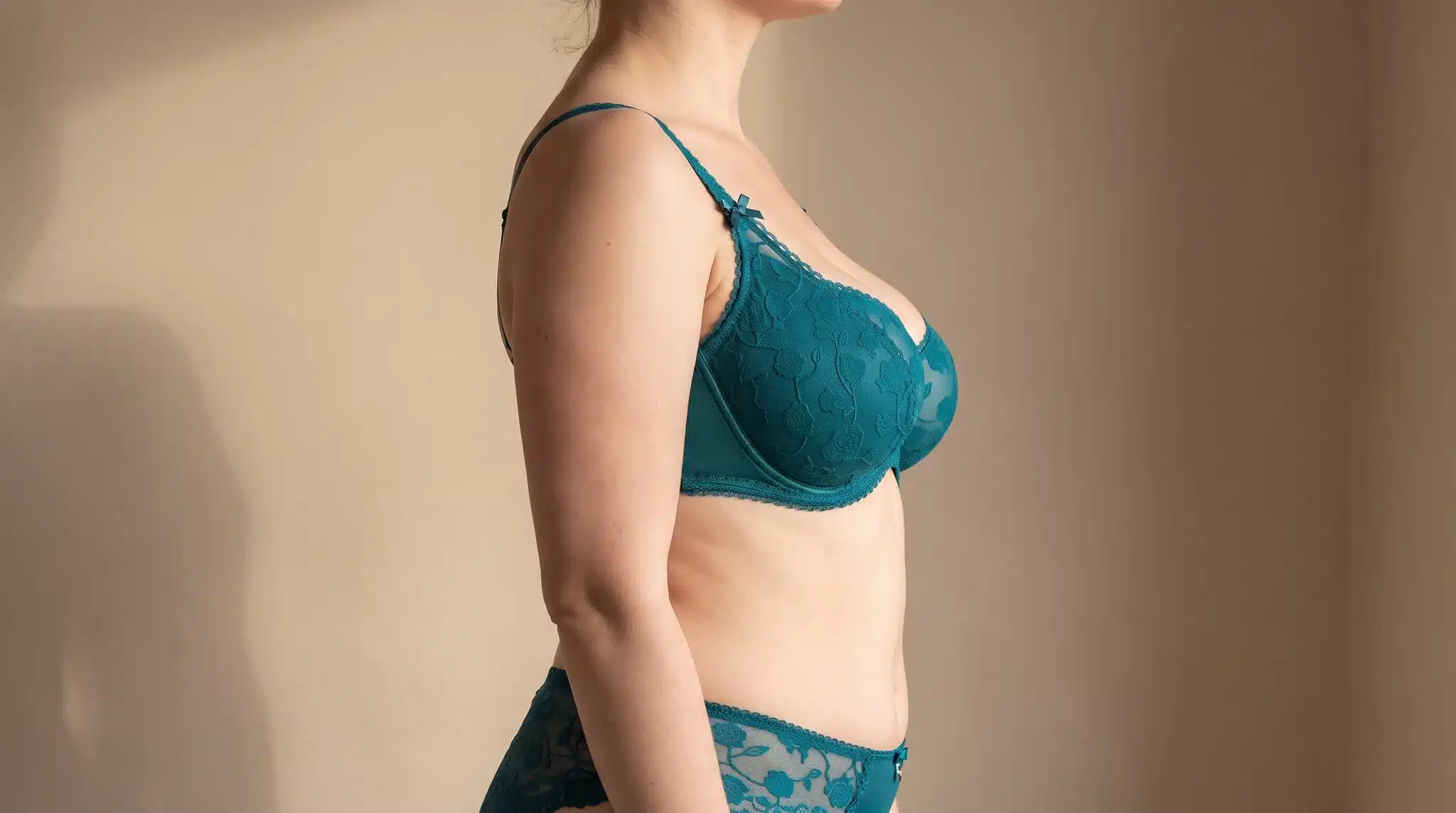
At a glance: The cup size is the difference between the bust measurement and the underbust measurement, both measured horizontally: 12 to 14 cm give cup A, 16 to 18 cm cup C, 18 to 20 cm cup D.
- Worked example: underbust measurement 78 cm, bust measurement 96 cm, difference 18 cm, gives size 80D
- Sister sizes: if the calculated size does not fit, one band size smaller with one cup size larger helps: 75B becomes 70C, 75C becomes 70D
- Fit: according to studies, up to 80 percent of all women wear a bra that does not fit properly
- Pregnancy and breastfeeding: breast volume often increases by one to two cup sizes
- Implant volume: about 150 ml corresponds roughly to one cup size, though only as a very simplified rule of thumb
Determining Your Cup Size — How to Find Your Ideal Bra Size
Knowing your correct cup size matters more than many women realise. A well-fitting bra plays a central role not only in everyday comfort but also in how you perceive your own body. Studies suggest that up to 80 percent of all women wear a bra that does not fit properly. In this guide, you will learn how to determine your cup size correctly, which factors influence breast size, and when a conversation with a specialist in plastic and aesthetic surgery may be worthwhile.
What Exactly Is the Cup Size?
The cup size describes the volume of the breast in relation to the underbust circumference. It is determined by the difference between the bust circumference and the underbust circumference. The greater this difference, the larger the cup.
An important point to understand: the cup size alone tells you very little. A C cup with an underbust of 70 has a different volume than a C cup with an underbust of 85. This is why it is always the combination of underbust circumference and cup size that is decisive.
Measuring Your Cup Size Correctly — Step by Step
To determine your cup size precisely, you will need a flexible measuring tape and, ideally, a well-fitting, non-padded bra.
Step 1: Measure the underbust circumference
Place the measuring tape directly beneath the breast, horizontally around the body. The tape should sit snugly but not cut in. Breathe normally. Note the value in centimetres.
Step 2: Measure the bust circumference
Now measure around the fullest part of the breast, again horizontally around the body. Make sure the measuring tape is neither too tight nor too loose.
Step 3: Calculate the difference
Subtract the underbust circumference from the bust circumference. This difference gives you your cup size according to the following table:
Bra Size Chart: Cup Size by Underbust Circumference
The following table shows the most common bra sizes in the European system. Measure your underbust circumference and bust circumference and read off your size:
| Underbust circumference | Cup A (12–14 cm) |
Cup B (14–16 cm) |
Cup C (16–18 cm) |
Cup D (18–20 cm) |
Cup E (20–22 cm) |
Cup F (22–24 cm) |
|---|---|---|---|---|---|---|
| 63–67 cm | 65A | 65B | 65C | 65D | 65E | 65F |
| 68–72 cm | 70A | 70B | 70C | 70D | 70E | 70F |
| 73–77 cm | 75A | 75B | 75C | 75D | 75E | 75F |
| 78–82 cm | 80A | 80B | 80C | 80D | 80E | 80F |
| 83–87 cm | 85A | 85B | 85C | 85D | 85E | 85F |
| 88–92 cm | 90A | 90B | 90C | 90D | 90E | 90F |
| 93–97 cm | 95A | 95B | 95C | 95D | 95E | 95F |
| 98–102 cm | 100A | 100B | 100C | 100D | 100E | 100F |
How to read the table: First find your underbust circumference in the left-hand column. Then calculate the difference between your bust circumference and your underbust circumference. The column headings show which cup size corresponds to which difference. Example: underbust 78 cm, bust 96 cm → difference 18 cm → 80D.
Sister sizes — the flexible alternative
Not every bra fits the same way. If your calculated size does not sit perfectly, so-called sister sizes can help. The principle: one band size smaller paired with one cup size larger — or vice versa. The breast volume remains almost the same.
| Your size | Sister size (smaller) | Sister size (larger) |
|---|---|---|
| 75B | 70C | 80A |
| 80B | 75C | 85A |
| 75C | 70D | 80B |
| 80C | 75D | 85B |
| 75D | 70E | 80C |
| 80D | 75E | 85C |
Please note: Sizing systems differ between manufacturers and countries. European, British and American sizes can in some cases deviate considerably from one another. When in doubt, a professional bra fitting in a specialist store is recommended.
Which Factors Influence Cup Size?
The size and shape of the breast change over the course of a lifetime. Several factors play a role here:
Genetics
Genetic predisposition largely determines which breast size a woman develops. The shape, the quality of the skin and the elasticity of the tissue are also genetically influenced.
Weight fluctuations
Because the breast consists to a large extent of fatty tissue, the cup size often changes noticeably with weight gain or loss.
Pregnancy and breastfeeding
During pregnancy and breastfeeding, breast volume frequently increases by one to two cup sizes. After weaning, a loss of volume may occur, sometimes accompanied by a change in breast shape.
Hormonal changes
The menstrual cycle, hormonal contraception and menopause can all influence breast size. Many women notice cyclical fluctuations of half a cup size to a full cup size.
Age
With increasing age, the ratio of glandular tissue to fatty tissue changes. The skin loses elasticity, which can lead to a change in the shape and position of the breast.
When Women Consider Changing Their Cup Size
There are various reasons why women feel dissatisfied with their cup size. Some perceive their breasts as too small in proportion to their body, while others experience physical discomfort from breasts they feel are too large, such as back pain, postural problems or skin irritation.
Common circumstances that prompt women to engage with the topic more closely include:
- Asymmetry — one breast is noticeably larger than the other
- Loss of volume after pregnancy or weight loss
- Physical discomfort with very large breasts
- Dissatisfaction with breast shape after weight fluctuations
- Congenital differences such as tubular breast
Cup Size and Breast Augmentation — What You Should Know
Many women who think about their cup size eventually also consider a breast augmentation. This is a very personal decision-making process that requires time and well-founded guidance.
An important point to know: with a breast augmentation, you do not simply „order“ a particular cup size. The outcome depends on many individual factors:
- Starting point: existing breast tissue, skin quality, breast width
- Body proportions: shoulder width, hip circumference, height
- Tissue elasticity and skin condition
- Personal preferences and life circumstances
An experienced specialist in plastic and aesthetic surgery will take all of these factors into account during a detailed consultation and plan an outcome together with you that suits your body and your wishes.
Silicone implants and cup size
As a rough guide, an implant volume of around 150 ml corresponds to approximately one cup size. However, this rule of thumb is highly simplified. The actual outcome is influenced by the implant shape (round or anatomical), the placement (above or below the chest muscle) and the individual anatomy.
In a personal consultation at BONITAS, we take ample time to understand your wishes and to plan a natural, harmonious outcome. Alejandro Martí, specialist in plastic and aesthetic surgery, will discuss all of the options with you so that you can make an informed decision.
Frequently Asked Questions About Cup Size
How accurately can I measure my cup size at home?
Measuring at home gives a good orientation, but it can vary slightly depending on your technique and the measuring tape. For a precise result, a professional measurement in a specialist store is recommended. It is best to measure in the morning, as the breast can swell slightly over the course of the day.
Does cup size change with age?
Yes. Hormonal changes, weight fluctuations, pregnancies and the natural ageing process all alter breast size and shape over the course of a lifetime. It is advisable to have your bra size checked regularly — about once a year.
When is a conversation with a plastic surgeon worthwhile?
If you are distressed by the size or shape of your breasts — whether physically through discomfort or emotionally through significant dissatisfaction — a no-obligation consultation can provide clarity. During the consultation, all of the options are discussed without any commitment on your part.
Can I choose a specific cup size for a breast augmentation?
An exact cup size cannot be guaranteed, as the outcome depends on the individual anatomy. An experienced specialist can, however, assess very accurately which implant volume will lead to a natural, proportional result that comes close to your wishes.
Which cup size looks the most natural?
There is no universal answer. A natural result is achieved when the breast size suits the body proportions. During the consultation, we work out together with you which outcome feels coherent and natural for you.
Medically reviewed and written by:
Alejandro Martí – Specialist in Plastic and Aesthetic Surgery 🇩🇪 🇪🇸
Last reviewed: April 2026
References & Scientific Sources
- Choppin SB et al. „The accuracy of breast volume measurement methods: A systematic review.“ Breast (Edinburgh, Scotland). 2016. PubMed PMID 27288864
- Markovic A et al. „Assessment of Three Breast Volume Measurement Techniques: Single Marking, MRI and Crisalix 3D Software(®).“ Aesthetic Plastic Surgery. 2023. PubMed PMID 37337054
- Xi W et al. „Objective breast volume, shape and surface area assessment: a systematic review of breast measurement methods.“ Aesthetic Plastic Surgery. 2014. PubMed PMID 25338712
- Gouveia PF et al. „3D Breast Volume Estimation.“ European Surgical Research. Europaische Chirurgische Forschung. Recherches Chirurgicales Europeennes. 2022. PubMed PMID 34038908
- Utsunomiya H et al. „Longitudinal Volume Assessment of Reconstructed Breast Using Three-Dimensional Measurement: How Do DIEP and LD Flap Change Immediately after Surgery?.“ Indian Journal of Plastic Surgery: Official Publication of the Association of Plastic Surgeons of India. 2024. PubMed PMID 38774730