
Round or Anatomical Breast Implants?
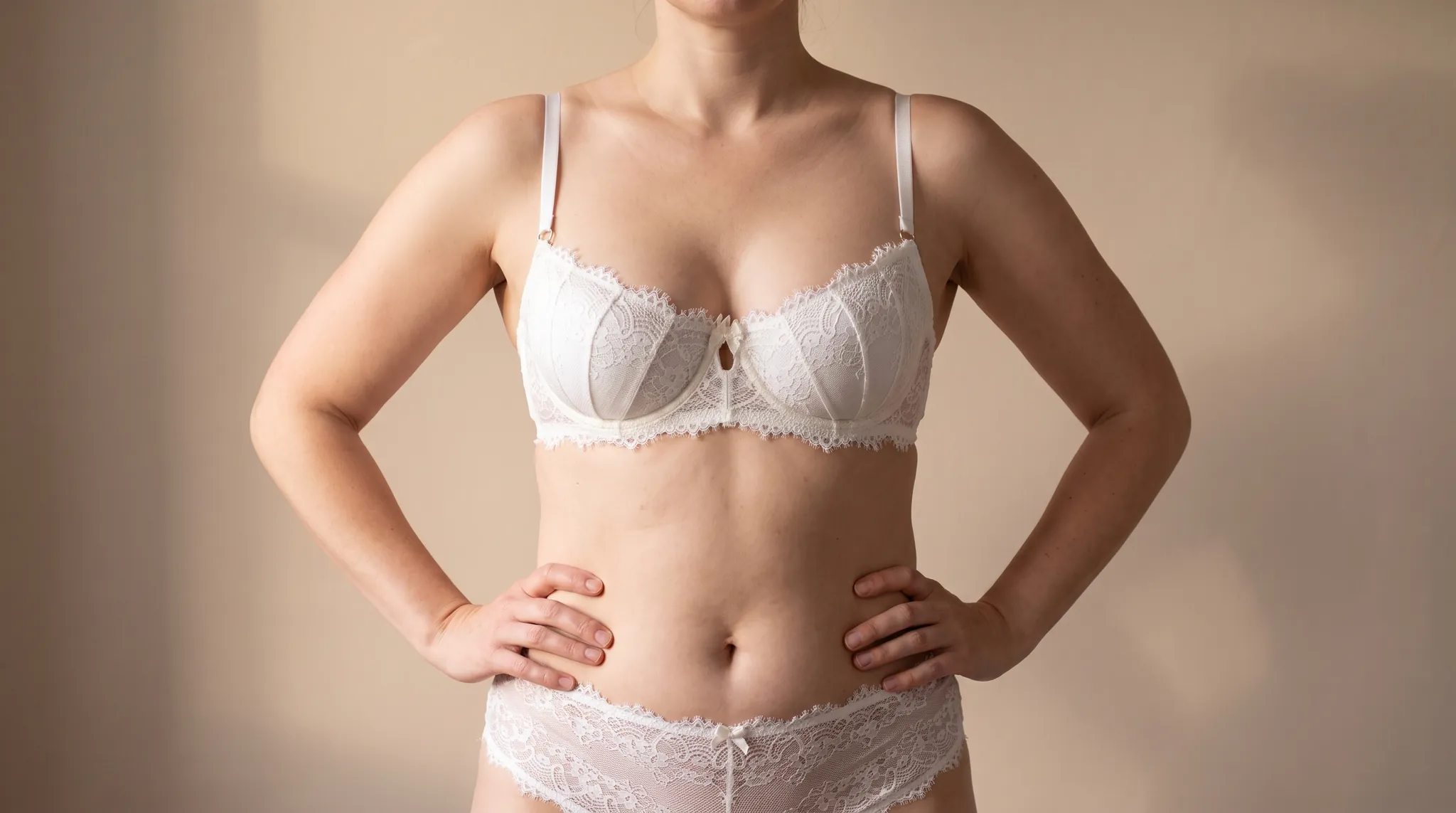
You are considering a larger or more harmonious breast and keep coming across the same question in your research: round or anatomical? Both implant shapes are used in breast augmentation, yet they create different aesthetic emphases. The round shape tends to accentuate fullness in the upper pole and the décolletage, while the anatomical shape – often called teardrop-shaped – traces a softer transition from top to bottom. Which shape is suitable for you depends less on a blanket rule than on your baseline anatomy, your skin quality and the result you have in mind. This article compares both shapes honestly and without sweeping conclusions – so that you can enter your consultation well prepared.
Round vs. anatomical implants: the key difference in shape
The most important difference lies in how the volume is distributed within the implant. A round implant carries the filler material evenly across the entire surface – projection is similar at the top and the bottom. An anatomical implant has more volume at the bottom than at the top; the contour tapers more gently toward the upper pole and thereby resembles the natural slope of many breasts.
From this, two distinct underlying aesthetic tendencies emerge:
- Round: often accentuates the upper portion of the breast, creating more visible fullness in the décolletage and a rounder upper pole.
- Anatomical: shifts the emphasis downward, which can produce a softer, more gradual transition from the breast base to the breast apex.
It is important to understand that which shape ultimately looks more natural cannot be determined in general terms. A comparative study, in which experienced observers compared round and anatomical implants intraoperatively, found no clear superiority of either shape with regard to outward appearance. This underscores that your individual tissue often plays a greater role in the result than the shape alone.
How implant shape influences the aesthetic result (décolletage, profile, transition)
The shape primarily affects three visible areas: the décolletage, the lateral profile and the transition between the chest wall and the breast.
Décolletage and upper pole
Anyone who wishes for a distinctly full breast with emphasis toward the top – for example a visibly rounder décolletage in fitted clothing – tends to find this effect more readily with round implants. Anatomical implants deliberately keep the upper pole flatter, which many people perceive as more understated and discreet.
Profile and projection
Regardless of shape, implants are available with different profiles, that is, with varying degrees of forward projection. A higher profile projects more for the same width. Shape and profile are considered together during planning: the aim is to complement your existing breast, not to overload it noticeably.
Transition and contour
The transition from the chest wall to the breast is the area where the teardrop shape produces its characteristic effect. It can help to create a soft, flowing slope – particularly when the baseline anatomy shows little of one’s own volume in the upper region. With firm, well-covering tissue, however, a round implant can also leave a very natural impression, because the tissue helps to shape the contour.
Who round implants may be more suitable for
Round implants are widely used in aesthetic surgery and are an option for many different starting situations. They may be a particularly good fit when:
- You deliberately wish for more fullness in the upper portion of the breast and an accentuated décolletage.
- Your baseline anatomy shows a rather flat upper portion of the breast that you would like to make rounder.
- You prefer a shape that behaves uniformly as the body changes position – because the volume is distributed all around, any rotation of the implant has no visual consequence.
Even with a thinner soft-tissue envelope, round, soft implants are frequently used, because the even distribution of volume can make contours less noticeable. Whether this makes sense in your case can only be assessed after an examination of your tissue.
Who anatomical (teardrop-shaped) implants may be an option for
Anatomical implants are considered when a particularly understated, downward-weighted build is the priority. They may be worth considering above all when:
- You prefer the gentlest possible transition from the chest wall to the breast and a flatter upper pole.
- Your baseline anatomy shows little breast tissue of your own and the contour is shaped more strongly by the implant.
- You value a shape that traces the natural teardrop slope rather than creating additional fullness at the top.
At the same time, an honest assessment includes acknowledging that anatomical implants bring with them certain shape-specific considerations – such as the question of orientation within the tissue. That is precisely the topic of the next section.
Rotation, palpability and further aspects of choosing the shape
The choice of shape concerns not only aesthetics but also practical considerations that belong in the informed-consent discussion:
- Orientation and rotation: Because an anatomical implant has a defined top-to-bottom axis, its correct position is relevant. If the position changes, this can affect the outward shape. A round implant does not have this axis – its shape remains visually the same when rotated.
- Palpability and visibility: With a thin soft-tissue envelope, implant edges or fine folding (rippling) may become more noticeable. Shape, fill, profile and the position of the implant together influence how likely this is.
- Tissue and skin quality: Firm, elastic skin with good coverage allows more creative latitude. With thinner or softer tissue, the selection is weighed more carefully, because the tissue conceals the shape less.
- Long-term perspective: An implant is a medical device, not a component for eternity. Regardless of shape, the possibility of later follow-up or a replacement belongs in the planning from the outset.
More recent studies additionally compare modern, soft round implants with anatomical models over longer observation periods and, depending on the starting situation, place their emphasis differently. This shows that there is no universally valid ranking – what matters is matching the choice to your circumstances.
How we determine the right shape together with you at BONITAS
In my practice, BONITAS, I do not view the choice of shape as a standard decision but as part of individual planning. During the consultation, we look at your baseline anatomy, your skin quality, your tissue thickness and, above all, your desired result. Only from this overall picture does it emerge whether a round or an anatomical shape better supports your expectations – or which combination of shape, size, profile and position makes the most sense.
It is important to me that you leave not with a finished proposal but with an understanding of the options. This also includes naming the limits openly: what your tissue can support well over the long term and which shape-specific aspects need to be considered. I am Alejandro Marti, a plastic surgeon (Facharzt für Plastische und Ästhetische Chirurgie) with specialist recognition in Germany and Spain. If you are considering breast augmentation, we will find the shape that suits you together and without pressure. You will find BONITAS at Kornmarkt 4, 90402.
A real fitting instead of 3D simulation: my personal method
Many practices advertise digital 3D simulations on a screen. I deliberately take a different path. With me, you try out different sizes directly using real trial prostheses (sizers) – you see and feel volume and weight immediately on your own body. This tactile sense of your own body gives you a more honest impression of the result than any image on a monitor.
On this basis, we then choose together the solution that suits you, one that fits optimally with your individual breast footprint, your breast base and your natural breast shape. This way, the decision is not made by software but by you – together with me.
Frequently asked questions
Are anatomical implants always more natural than round ones?
Not necessarily. Which shape looks more natural depends on your baseline anatomy, your skin quality and your tissue. With well-covering tissue, a round implant can also look very natural, because the tissue helps to shape the contour. Comparative studies show no general superiority of either shape.
Which shape gives more fullness in the décolletage?
The round shape tends to accentuate the upper portion of the breast more strongly and can create a fuller décolletage. Anatomical implants deliberately keep the upper pole flatter and weight the volume downward.
Can an anatomical implant rotate?
Because an anatomical implant has a defined top-to-bottom axis, its orientation within the tissue is relevant; if the position changes, this can affect the contour. A round implant does not have this axis and remains visually unchanged when rotated. How we assess this risk is something we discuss individually.
Literature & Scientific Sources
- Cheng F et al. „Round versus Anatomical Implants in Primary Cosmetic Breast Augmentation: A Meta-Analysis and Systematic Review.“ Plastic and Reconstructive Surgery. 2019. PubMed PMID 30601325
- Hidalgo DA et al. „Intraoperative Comparison of Anatomical versus Round Implants in Breast Augmentation: A Randomized Controlled Trial.“ Plastic and Reconstructive Surgery. 2017. PubMed PMID 28234826
- Namnoum JD et al. „Primary breast augmentation clinical trial outcomes stratified by surgical incision, anatomical placement and implant device type.“ Journal of Plastic, Reconstructive & Aesthetic Surgery: JPRAS. 2013. PubMed PMID 23664574
- Rocco N et al. „Different types of implants for reconstructive breast surgery.“ The Cochrane Database of Systematic Reviews. 2016. PubMed PMID 27182693
- Hidalgo DA et al. „Breast augmentation.“ Plastic and Reconstructive Surgery. 2014. PubMed PMID 24675209
- Graf RM et al. „Ergonomix versus Round Implants: A Comprehensive Evaluation of Aesthetic Outcomes and Long-Term Follow-Up in Breast Surgery.“ Plastic and Reconstructive Surgery. 2026. PubMed PMID 41086305
Medically reviewed and written by Alejandro Marti – plastic surgeon (Facharzt für Plastische und Ästhetische Chirurgie, DE & ES). Last reviewed: May 2026.