
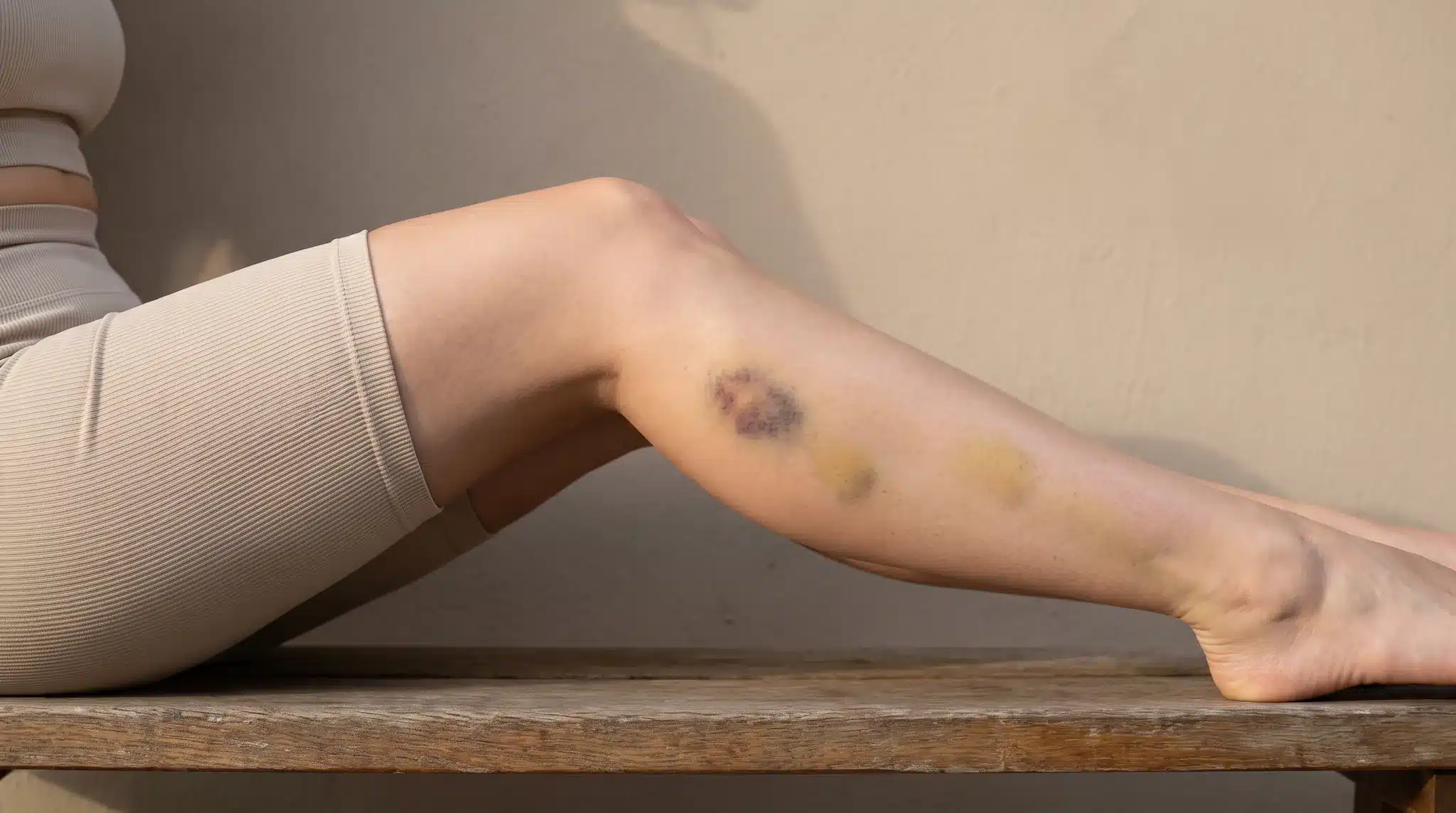
At a glance: A bruise forms when small blood vessels under the skin tear and blood leaks into the surrounding tissue. If haematomas appear repeatedly without an obvious reason or after minimal contact, lipedema can be behind it.
- Why in lipedema: because of the mechanical tension in the increased subcutaneous fat tissue, the capillaries tend to tear more easily, and haematomas can follow from the slightest pressure
- Stage 1: bruises often as the first physical signal, accompanied by pressure pain and slightly swollen legs
- Stage 2: haematomas become more frequent, larger and more painful, and dents and nodules show up in the tissue
- Stage 3: haematomas sometimes appear spontaneously, simply from wearing tight clothing
- Rule out other causes: often a vitamin K or vitamin C deficiency is behind it, and a blood test brings clarity
Inconspicuous, yet often the first visible sign: bruises that appear seemingly without cause can be more than harmless hematomas. In women in particular, their frequent occurrence not uncommonly marks the beginning of a years-long odyssey – frequently triggered by an undiagnosed lipedema. While many physicians dismiss spontaneous bruising as trivial, those affected repeatedly report similar symptoms. The connection between lipedema and bruising is still underestimated.
What are bruises?
Typical causes of hematomas
A bruise develops when small blood vessels beneath the skin rupture and blood leaks into the surrounding tissue. Contusions or knocks are usually the trigger – the process becomes visible through the characteristic discoloration of the skin, which changes over the course of several days.
When does a bruise become unusual?
It becomes a concern when hematomas appear without any apparent cause or after minimal contact – especially when they recur or appear in unusual areas of the body. In such cases, an underlying medical problem may be present, such as vascular fragility or – as in many affected individuals – a lipedema.
Sudden bruising without an apparent cause
Why spontaneous bruising should not be ignored
When bruises appear regularly without an identifiable trigger, this should be taken seriously. Increased vascular fragility is often behind it, which may point to a chronic condition – in middle-aged women, particularly often to lipedema.
Medical evaluation in cases of recurrent hematomas
Many patients are initially investigated for suspected coagulation disorders. If this finding is unremarkable, the symptom is often not pursued further – a mistake, because lipedema in particular frequently remains undetected in its early stage.
The connection between lipedema and bruising
How lipedema affects vascular structure
Lipedema is an abnormal increase in subcutaneous fatty tissue, primarily on the legs and arms. In the process, the capillaries become more vulnerable – due to the mechanical tension within the tissue, they are more prone to rupturing. The result: hematomas at the slightest pressure.
Why those affected are often not taken seriously
The pain, the feeling of tightness, the tendency to bruise – many of these symptoms are considered „nonspecific“. Those affected are still often led to believe that they simply need to „lose weight“. Yet lipedema has nothing to do with being overweight, and it progresses when left untreated.
Bruising in lipedema
Lipedema Stage 1
In the early phase, bruises often appear as the first physical signal – accompanied by pressure pain and slightly swollen legs. The skin is still smooth but sensitive. Many patients in Lipedema Stage 1 report increased hematomas without having knocked themselves.
Lipedema Stage 2
Over time, dimpling and nodules increasingly appear within the tissue. The fatty accumulation advances and the lymphatic system comes under pressure. In Lipedema Stage 2, hematomas become more frequent, more extensive and more painful. The body reacts more sensitively to pressure loads.
Lipedema Stage 3
Here the changes are clearly visible: hardened fat pads, marked increase in circumference and significant limitations in everyday life. In Lipedema Stage 3, hematomas sometimes arise spontaneously – simply from wearing tight clothing. Quality of life is considerably reduced.
BONITAS supports you through every stage
Individualized diagnostics and long-term care for lipedema at BONITAS
At BONITAS, patients with lipedema are the focus. From the first diagnosis to follow-up care, the specialist center provides well-founded support across all stages. The frequency of bruising is not played down but regarded as a symptom to be taken seriously – particularly when it occurs together with typical signs of lipedema.
Whether in an early stage or with advanced symptoms: anyone who suffers from bruising without cause should not ignore it. A specialized examination can provide clarity. BONITAS supports patients with empathy, expertise and modern technology – from the first consultation through to surgical treatment. Further information about the treatment options for lipedema or about the individual lipedema stages can be found directly on our website.
FAQ on bruising
What is the reason for bruising without having knocked yourself?
Bruises with no recognizable cause can indicate increased vascular fragility or an underlying condition such as lipedema. Women with lipedema in particular report hematomas after light pressure or even without any external trigger. Coagulation disorders, medications or vascular diseases may also be behind it. A medical evaluation is advisable in any case.
What deficiency do you have if you bruise easily?
A vitamin K deficiency or vitamin C deficiency is often responsible for an increased tendency to bruise. These vitamins are essential for blood clotting and vascular protection. A deficiency weakens the capillaries, so that even slight pressure can lead to hematomas. Iron and zinc deficiency can also indirectly weaken the connective tissue. A blood test provides clarity.
Which condition causes bruising?
Bruising occurs in various conditions. Alongside coagulation disorders (such as hemophilia) or blood diseases (e.g. leukemia), lipedema can also be a frequent cause – especially in women. In this case, altered fatty and connective tissue leads to increased capillary sensitivity. Liver diseases and autoimmune disorders can also cause hematomas.
Which vitamin is lacking if you bruise easily?
In most cases it is a vitamin K deficiency, which impairs blood clotting. A vitamin C deficiencycan also reduce the stability of the blood vessels and thus increase the tendency to bruise. In both cases, targeted nutritional supplementation can be helpful – but should only take place after a medical diagnosis.
Medically reviewed and written by:
Alejandro Martí – Specialist in Plastic and Aesthetic Surgery 🇩🇪 🇪🇸
Last reviewed: April 2026
References & Scientific Sources
- Modi AV. „Spontaneous Bruising in a Family Practice Population: How common and how benign is it?.“ Canadian Family Physician Medecin de Famille Canadien. 1992. PubMed PMID 21221312
- Sham RL, Francis CW. „Evaluation of mild bleeding disorders and easy bruising.“ Blood Reviews. 1994. PubMed PMID 7950480
- Kouides PA. „Evaluation of abnormal bleeding in women.“ Current Hematology Reports. 2002. PubMed PMID 12901120
- McGuire C et al. „Role of Tranexamic Acid in Reducing Intraoperative Blood Loss and Postoperative Edema and Ecchymosis in Primary Elective Rhinoplasty: A Systematic Review and Meta-analysis.“ JAMA Facial Plastic Surgery. 2019. PubMed PMID 30605219
- O’Brien SH. „An update on pediatric bleeding disorders: bleeding scores, benign joint hypermobility, and platelet function testing in the evaluation of the child with bleeding symptoms.“ American Journal of Hematology. 2012. PubMed PMID 22460356